
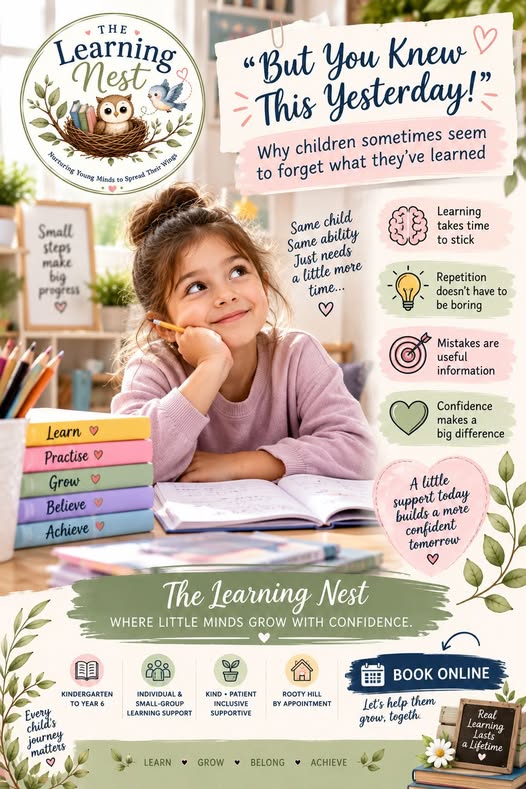
 “BUT YOU KNEW THIS YESTERDAY!” — WHY CHILDREN SOMETIMES SEEM TO FORGET WHAT THEY’VE LEARNED
Have you ever sat beside your child while they confidently completed a maths problem, read a tricky word or remembered a spelling rule… only for the next day to arrive and suddenly it seems to have disappeared? 
You might find yourself thinking:
“But we literally did this yesterday!”
If this sounds familiar, you’re certainly not alone.
One of the important things to understand about children’s learning is that being able to do something once doesn’t necessarily mean that skill has been permanently learned yet.
 LEARNING TAKES TIME TO STICK
When children first learn something new, their brain is beginning to create connections around that information.
At first, those connections may still be quite fragile.
A child might successfully solve a problem while the explanation is fresh in their mind, but have difficulty retrieving the same information later without a reminder.
That doesn’t necessarily mean the original lesson failed.
It often means the learning needs more opportunities to be recalled, practised and used in different ways.
Think of it a little like creating a pathway through grass. 
Walk across it once and there may barely be a mark.
Walk across it repeatedly and eventually a clear pathway begins to form.
Learning can work in a similar way.
 REPETITION DOESN’T HAVE TO MEAN BORING WORKSHEETS
Practising a skill repeatedly is valuable, but children don’t necessarily need to complete page after page of identical questions.
In fact, practising the same concept in different contexts can help children understand it more deeply.
If a child is learning addition, for example, they might:
 Add pieces of fruit
 Count LEGO bricks
 Play a number game Solve written equations
 Add pretend shopping prices
 Count or measure ingredients while cooking
The mathematical idea remains the same, but the child encounters it in several different situations.
This helps move learning beyond simply remembering how one particular worksheet worked.
MISTAKES ARE USEFUL INFORMATIONWhen a child forgets something, adults naturally want to correct the answer immediately.
Sometimes, however, giving them a little time to think can be more valuable.
Try prompts such as:
“What do you remember about this?”
“What could we try first?”
“Does this remind you of something we’ve done before?”
Even when the child doesn’t retrieve the entire answer, attempting to remember is itself part of the learning process.
And their mistake can tell us something useful.
Perhaps they understand the concept but have forgotten one step. Maybe the instructions are confusing. Perhaps they need something demonstrated visually rather than verbally.
Instead of simply seeing wrong answers, we can look for clues about where the learning became difficult.
 CONFIDENCE MATTERS TOO
There is another reason a child may suddenly struggle with something they previously demonstrated successfully.
They may be tired.
They may feel rushed.
They may be distracted.
They may be worried about getting the answer wrong.
Or they may have convinced themselves:
“I can’t do this.”
Once frustration takes over, retrieving information can become much harder.
That’s why supporting children’s confidence is an important part of education.
Sometimes the best response isn’t another explanation.
It might simply be:
“That’s okay. Let’s work through the first part together.”
That small amount of reassurance can make an enormous difference.
 AT THE LEARNING NEST
At The Learning Nest, I believe learning shouldn’t be a race.
Children develop skills at different speeds and in different ways. Some children need additional repetition. Others benefit from visual explanations, practical activities, quieter learning environments or simply a little more time.
My aim is not only to help children complete today’s work.
It is to help them gradually develop the understanding, skills and confidence that allow them to approach tomorrow’s work with a little more independence.
So the next time your child looks at something they successfully completed yesterday and announces…
“I DON’T KNOW HOW TO DO THIS!” 

Don’t panic.
Their learning hasn’t necessarily disappeared.
That little pathway in their brain may simply need to be travelled a few more times. 
THE LEARNING NESTWhere little minds grow with confidence.
 Kindergarten to Year 6 Individual & small-group learning support